The quality
control of Hitech Electronic System products starts from basic raw material and continue
right upto all stages of production down to finished product testing & even
to final usage of where we extend services to our customer in the proper
handling of the product.
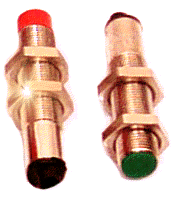
Testing of raw material
- All
electronic components such as resistors, capacitors, transistors, diodes,
zener diodes, voltage regulator IC's, SCR's, op-amps, special purpose Ics,
etc are checked for acceptance and are shifted to production department
for actual usage.
- As these
components are required in huge quantity, the method of sampling
inspection is adapted. The sampling plan is as follows :
|
Lot No. |
% for inspection |
Remark |
| 200
nos. |
20
% |
Accept # rejection < 5% |
| 500
nos. |
15
% |
Rejection > 5% =>
additional 10 % to be checked =>
overall rejection, 5% : accept the lot |
|
1000 nos. |
10
% |
-----------do----------- |
- Metallic /
plastic enclosures are tested and checked for physical dimensions such as
diameter, pitch, length, and other parameters at the suppliers site.
Necessary gauges & dies are developed by
Hitech Electronic System and kept at the vendors’
premises.
- The PCB’s are subject to 100 % inspection for
visual inspection such as track cracks, tinning, dimensions, shorting,
etc. The track thickness is checked by thickness gauge. The track
thickness should be minimum 8 microns.
To ensure
minimum rejection at the final stage and best possible quality of product,
inspection is carried out at various stages of manufacturing.
In-process
Quality Control :
-
Temperature test :
All
components are inserted and soldered on PCB. After this, the populated
PCB’s are checked for circuit working. The rejected populated PCB’s are
sent, for reworking PCB’s are kept in laboratory oven @ 55oC
for one hour and then tested for circuit working. The rejected PCB’s are
scrapped. The accepted PCB’s are then sent for vibration test.
-
Vibration test :
PCB’s are kept on vibration plate which vibrates at 50 Hz with 1 mm
amplitude. This test help us to find out hidden dry solders and solder
point cracks.
-
Electrical / other parameter testing :
Sensing distance with respect to supply voltage, No load current, maximum
output current, short circuit protection, reverse polarity protection, etc
is tested. 100 % inspection is carried out for above mentioned tests. At
this stage depending upon specific requirement of customer, certain tests
are carried out ; e.g. in certain applications customer may be requiring
25 % hysterisis as against standard 10 %. Such instructions are included
in the job sheet prepared by the marketing engineer.
- Accepted
PCB’s are then sent to the potting area where PCB’s are placed into the
metallic/non-metallic housings. Depending upon the product potting is
carried out These potted/unpotted products are then sent to final
inspection stage and then to despatch department.
Finished good Inspection
Following
tests are carried out in general. (Other tests are carried out depending
upon specific requirement of customer).
- No load
current
- Output
current
- Voltage
test
- Hysterisis
- Sensing
distance variation
- Short
circuit protection
- Reverse
polarity protection
- Cable
colour code
- Physical
dimensions
Non confirming products are scraped immediately.
Accepted
switches are then subjected to final heat run test. Here the switches are
kept in ON condition for 3 hours, in OFF condition for 1 hour and again in
ON condition for 3 hours.
The sampling
plan is as follows :
- upto 50
nos. => 25% random samples
=> 2 nos. rejected
=> additional 25 %
- upto 100
nos. => 20 % random samples
=> 2 nos. rejected
=> additional
=> 20 %
- More than
100 nos => 15% random
samples => 2 nos. rejected
=> additional 10%
To avoid any
delay in delivery schedule, due to final stage inspection : usually 5% more
than the order quantity is taken for processing.
Note : Above
mentioned tests, specifications varies with respect to the type of
switch/product such as diameter, sensing distance, enclosure configuration,
load technique, load logic, output load requirement, hysterisis, switching
frequency etc.

|


